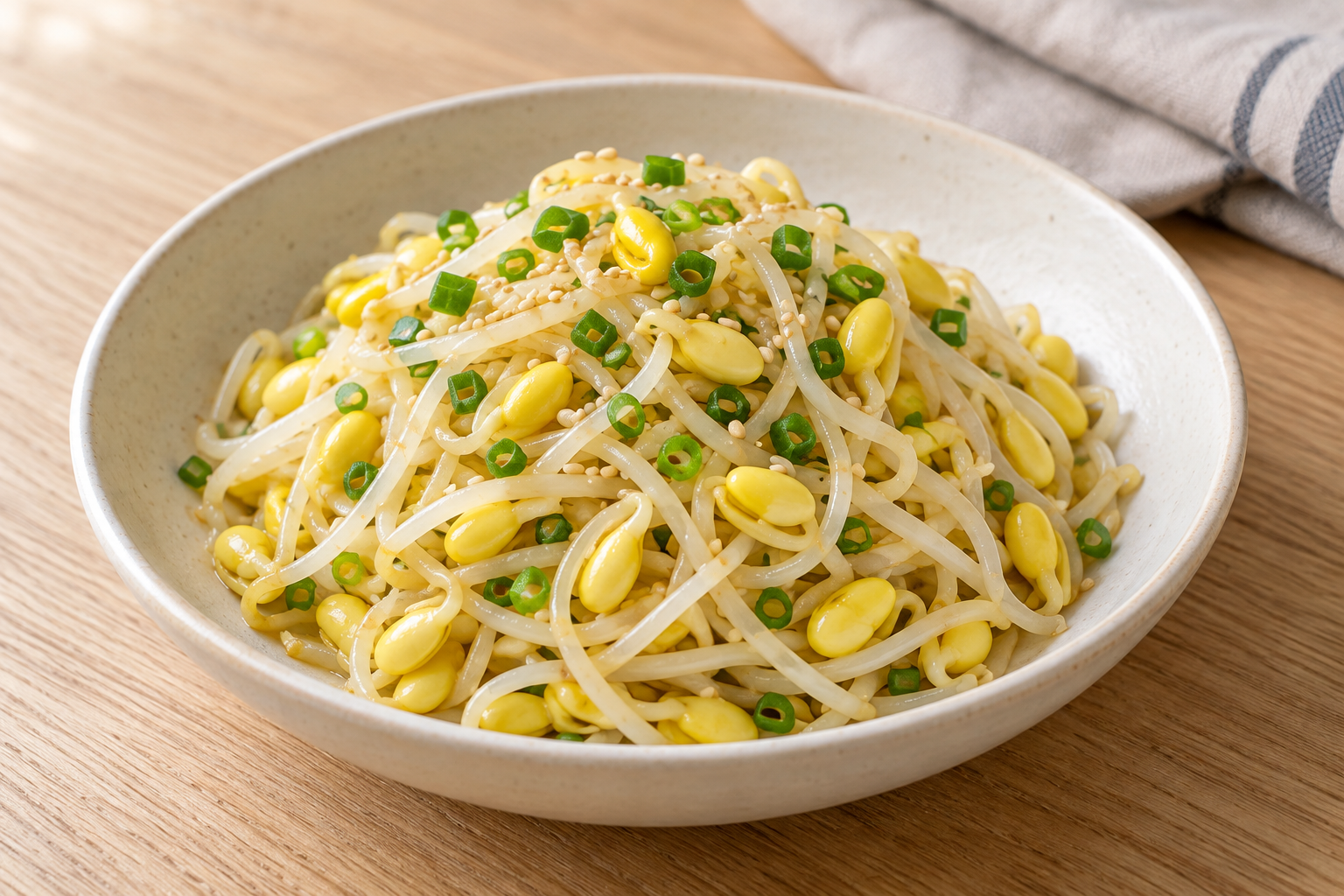
Kongnamul muchim (콩나물무침) is a Korean side dish of cooked soybean sprouts lightly tossed with garlic, scallion and sesame oil. This mild version starts with 300g of trimmed sprouts and uses salt instead of soy sauce or fish sauce. Cook first, drain well, and add the final seasoning in small amounts.
Yield: 2–3 small side-dish servings · Estimated time: about 20 minutes, including boiling water and draining. Use a 15mL tablespoon and a 5mL teaspoon. These amounts are an adjustable starting formula, not a personally cooked-and-tested review. All four images are AI-generated illustrations.
Ingredients for 300g of soybean sprouts

- Soybean sprouts — 300g / about 10.6oz after washing and trimming
- Water for cooking — About 1L / 4 metric cups, adjusted to cover the sprouts
- Salt for seasoning — Start with 2g and reserve some for final adjustment
- Minced garlic — 3g, about 1/2–2/3 teaspoon
- Chopped scallion — 10g
- Toasted sesame oil — 5mL / 1 teaspoon
- Toasted sesame seeds, optional — 1 teaspoon
Soybean sprouts are different from mung bean sprouts
Look for kongnamul or soybean sprouts at a Korean grocery store. They have noticeable yellow soybean heads attached to pale stems. Mung bean sprouts, often sold simply as “bean sprouts,” are a different ingredient with smaller heads and a different texture. Do not assume that a bag of unnamed sprouts needs exactly the same cooking time. Follow the package directions for the product you actually buy. Keep sprouts refrigerated according to the label and check the use-by date.
1. Sort and rinse
Prepare a clean bowl, colander, saucepan and utensils. Remove damaged bean heads and loose skins, then rinse under running water. Trimming every root is optional; focus on damaged or dirty parts. Do not try to rescue spoiled, slimy or rotten-smelling sprouts by washing or cooking them. Keep the clean equipment separate from utensils used for raw meat or fish.
2. Cook in boiling water
Bring about 1L of water to a boil in a roomy saucepan. Add the 300g of sprouts, let the water return to a boil, and maintain a steady boil over medium-high heat. Use about 5 minutes after the water returns to a boil as a starting guide. This version cooks uncovered from the start. Gently turn the sprouts with tongs so they heat evenly. If necessary, add boiling water to keep them covered, allowing enough room to prevent a boil-over.

Cook the bean heads thoroughly as well as the stems. Product cooking directions take priority, and thicker heads or a crowded pan may need longer. A fixed number of minutes, smell or appearance alone is not a safety guarantee. FDA guidance notes that raw or lightly cooked sprouts can carry harmful bacteria; do not stop short of thorough cooking just to preserve crunch.
3. Drain without wringing
Transfer the fully cooked sprouts to a clean colander and drain for about 2–3 minutes. Keep the colander above any liquid collecting underneath. Spread the sprouts gently to release steam instead of twisting them tightly, which can break the stems. This method does not call for another soak in cold water. Use utensils while the sprouts are hot and cool only enough to handle; do not leave them sitting out for a long period.
4. Toss and adjust the seasoning
Put the drained sprouts, garlic and scallion in a bowl. Sprinkle over only part of the initial 2g of salt and gently lift and fold with two utensils. Add sesame oil and optional sesame seeds, then toss again. Taste a fully cooked piece and add the reserved salt in small pinches as needed. If liquid is pooling in the bowl, check the draining step before automatically adding more seasoning.

Serve a small portion
Transfer to a small dish and serve with rice. Use a clean serving utensil, putting out only what you expect to eat soon. Keep the rest out of the warm dining area. There is no soy sauce or fish sauce in this formula; adding either on top of the full salt amount changes the saltiness and flavor.

Troubleshooting: watery, salty or too garlicky
Watery? Drain thoroughly before seasoning next time and toss close to serving. If liquid appears after mixing, lift out the solids and taste again before adding salt. Too salty? Mix in a little separately cooked, unseasoned soybean sprouts. More sesame oil or sugar will not remove the salt. Strong raw garlic flavor? Stop adding garlic and start with only 1–2g next time. Do not use stronger seasoning to disguise undercooked sprouts.
Half and double batches
- Half batch: 150g sprouts — 1.5g garlic, 5g scallion, 2.5mL sesame oil, start with 1g salt, optional 1/2 teaspoon sesame seeds
- Double batch: 600g sprouts — 6g garlic, 20g scallion, 10mL sesame oil, start with 4g salt, optional 2 teaspoons sesame seeds
Adjust the cooking water to cover the sprouts rather than mechanically halving or doubling it. For 600g, use a larger saucepan or two batches. A crowded pot takes longer to return to a boil; doubling the ingredients does not simply double the cooking time. For a spicy variation, set aside a small fully cooked portion and mix in a little gochugaru to taste.
Allergens and refrigeration
Soybean sprouts contain soy; this recipe also uses sesame oil and optional sesame seeds. Check ingredient and allergy labels. Omitting soy sauce or fish sauce does not make the dish suitable for every dietary requirement.
Divide leftovers into small containers to cool, then refrigerate within 1–2 hours. UK Food Standards Agency guidance recommends a fridge at 0–5°C and eating leftovers within 48 hours. This is general guidance, not a guarantee independent of ingredient condition and time spent at room temperature. Follow product use-by dates and storage directions too.
Sources and another Korean side dish
Korean Bapsang — Kongnamul Muchim was consulted for the basic cooked, drained and seasoned structure. This article uses a separate 300g salt-seasoned formula and an uncovered, ample-water method. See FDA produce and sprout handling guidance and UK Food Standards Agency chilling guidance for handling and storage. Sources checked October 20, 2026.
For another mild side dish, try Sigeumchi Namul: Korean Spinach. Browse all K-Food recipes · 한국어 레시피 보기 →
답글 남기기