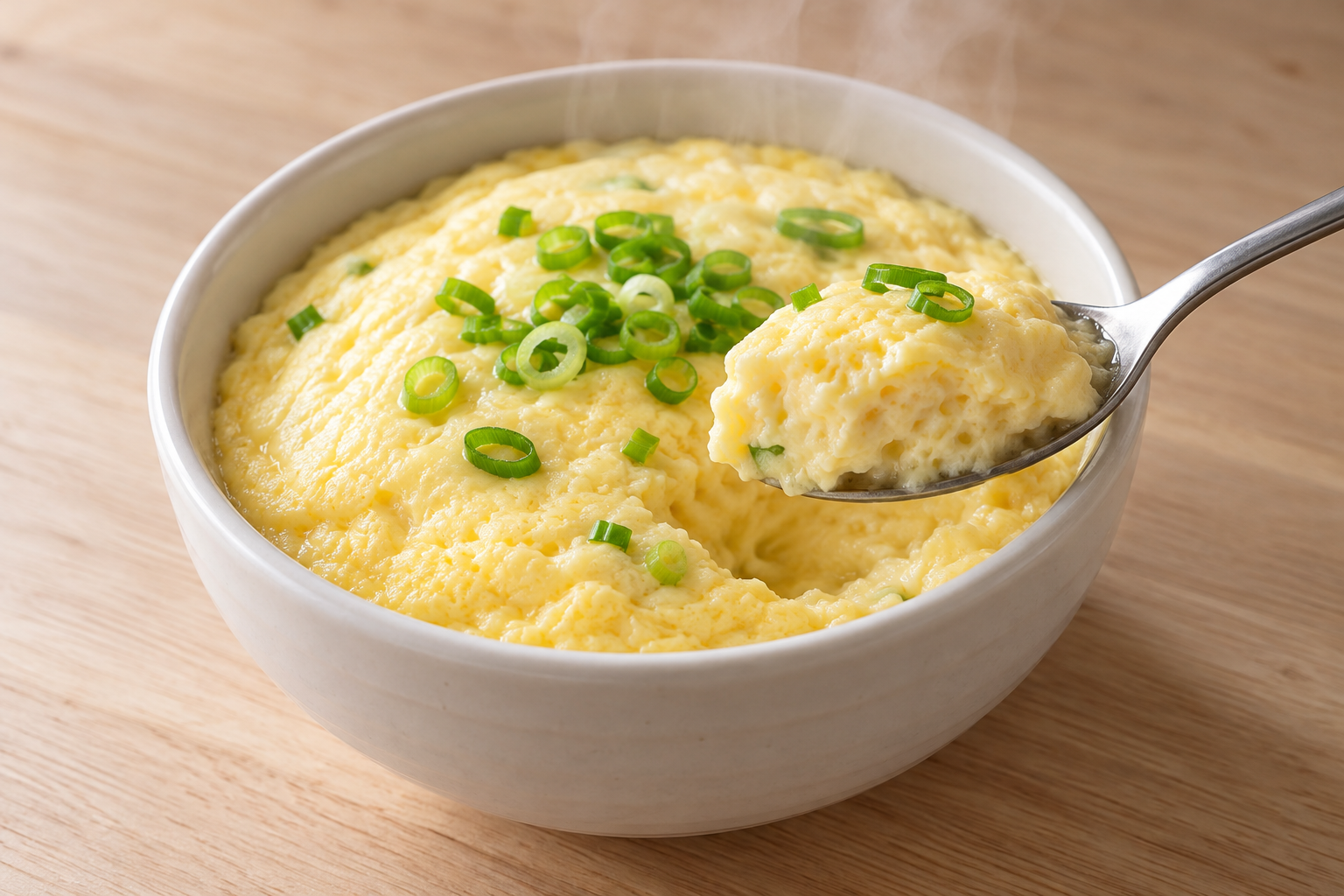
Gyeranjjim (계란찜) is a Korean savory egg custard served as banchan, or a side dish. This version uses a heatproof bowl inside a covered pot. A gentle water bath makes it easier to watch the heat than placing an ordinary bowl directly over a burner. The aim is a tender, fully cooked custard, rather than a dramatically puffed restaurant-style egg dome.
Yield: 2 small side-dish servings. Estimated time: 10 minutes preparation plus about 15–20 minutes heating; cold ingredients, thick bowls and deeper mixtures can take longer. Base ratio: approximately 150g shelled egg, usually 3 eggs, with 150mL water.
This is a measured cooking guide, not a personal cooking or tasting review. All four images are AI-generated process illustrations. They do not document an actual cooking session or establish exact quantities, temperature or doneness.
Ingredients · Method · Troubleshooting · 한국어 레시피 보기 →
Ingredients and the egg-to-water ratio
- 3 eggs, approximately 150g without shells
- 150mL water, or cooled unsalted stock
- 2g fine salt
- 10g finely sliced scallion
- Optional: about 2mL neutral cooking oil to lightly grease the bowl
Egg sizes vary, so weigh the contents when possible. The formula scales at 100g beaten egg to 100mL water and approximately 1.3g salt. Weigh salt rather than relying on a universal teaspoon conversion, because crystal sizes differ. With seasoned stock, reduce the salt according to the stock’s label and seasoning. Do not taste the raw egg mixture to adjust it.

Choose a suitable bowl and pot
The base mixture occupies roughly 300mL. A cooking-rated heatproof bowl of around 500–600mL is a useful starting size, with plenty of room above the mixture. Check its actual shape: a depth of about 3–4cm is more manageable than a narrow, deep column. Capacity alone does not tell you how quickly the middle will cook.
Use a pot that holds the bowl and a low metal steaming rack securely with the lid closed. The bowl must not wobble or float. Check that the manufacturer permits hot-water-bath cooking and sudden temperature changes; decorative ceramics and unspecified glass are unsuitable. A microwave-safe mark does not mean a bowl can sit directly on a stove. Prepare a sieve, scale, suitable bowl lifter or dry oven mitts, and a food thermometer.
1. Mix the eggs and strain
Crack each egg into a separate small dish before combining, checking for shell fragments and obvious deterioration. Whisk or stir just until yolks and whites are evenly combined, rather than whipping in lots of air. Dissolve 2g salt in 150mL water, then gradually stir it into the eggs. Cool stock before adding it so it does not partially cook the mixture.
Pass the mixture through a fine sieve once and skim away large surface bubbles. Without a sieve, break up the thick strands of white as thoroughly as possible, accepting that the texture may be less even. Lightly grease the cooking bowl if using the optional oil, pour in the mixture and scatter over half the scallion. Reserve the rest for finishing.

2. Set up the water bath
Test the rack and bowl in the cold pot first, then temporarily remove the bowl. Add enough water to touch the lower outside of the bowl when it is returned, generally no higher than one-third to halfway up its sides. The correct amount depends on the pot and rack; a fixed number of cups is less useful than checking the actual level.
Bring the water to a boil, reduce the heat and carefully lower the filled bowl onto the rack. If water splashes inside or the bowl starts to float, remove some water and make the setup stable before continuing. Keep hands out of the hot water and follow the bowl manufacturer’s guidance on thermal shock.
3. Cover and cook gently
Cover the pot and maintain a gentle simmer over low to medium-low heat. Leave the egg mixture undisturbed rather than repeatedly stirring it. Begin checking around 12 minutes; approximately 15–20 minutes is a starting range, not a promised finishing time for every stove, bowl or ingredient temperature.
Make sure the pot does not boil dry. If necessary, carefully add a little hot water outside the bowl. Open the lid away from your face and hands so steam escapes safely. If heavy condensation drips onto the custard, wipe the lid in a safe place before replacing it. Do not wrap it in cloth that can hang near a flame or other heat source.

4. Check the center, then serve
A slight wobble is different from liquid egg sloshing in the middle. If a gentle spoon check reveals runny egg, cover and cook for another 2–3 minutes before checking again. Use a food thermometer in the center without touching the bowl: 71.1°C / 160°F or above is the FDA target for egg dishes. Appearance alone cannot establish the same measurement.
Add the reserved scallion and cook covered for another minute if desired. Lift the bowl onto a heatproof mat and serve small portions. Both the bowl and its center may be extremely hot. Residual heat is not a reason to serve an undercooked center.

Troubleshooting texture and seasoning
- Firm edges but a runny middle: Continue the gentle bath instead of turning the heat to maximum. Next time, reduce the depth with a wider bowl or two smaller ones.
- Large holes or a coarse surface: Check for vigorous boiling, excessive whisking and prolonged heating. Straining cannot cancel the effect of harsh heat.
- A little clear water: It may be condensation or moisture separating after overcooking. Draining water does not cook raw egg, so check the middle before treating this as a cosmetic issue.
- Too salty: Serve a smaller amount alongside plain rice and reduce salt or stock seasoning next time. Adding raw egg to a cooked batch requires thoroughly cooking the whole mixture again.
- Scallion dominates: Start with 5g next time or omit it. Milk, salted shrimp and sesame oil are optional variations rather than requirements of this base recipe.
Half and double batches
Half batch: 75g beaten egg, 75mL water, 1g salt and 5g scallion. Weighing beaten egg is easier than estimating one and a half eggs. Cover and refrigerate unused raw beaten egg immediately and cook it promptly according to safe egg-handling guidance. Double batch: 300g egg, 300mL water, 4g salt and 20g scallion.
For a double batch, use two bowls or a wider suitable bowl to keep the mixture at a similar depth. Do not fill the same small bowl to the brim or simply double the cooking time. If two bowls cannot stand safely inside the pot, cook in separate batches and check each center.
Storage, reheating and allergens
Make only what you need when practical. Divide any portion being saved into clean shallow containers and refrigerate promptly; do not mix leftovers from a shared plate back into the storage batch. FDA guidance calls for refrigeration at 4°C / 40°F or below, using cooked egg dishes within 3–4 days, and reheating to 73.9°C / 165°F. Discard egg dishes left out for over 2 hours, or over 1 hour above 32°C / 90°F. These limits do not guarantee safety under poor handling conditions.
This dish contains egg. Check stock ingredients and cross-contact statements even when the stock is unsalted. Fish stock, salted shrimp or milk introduce other allergen considerations. A short ingredient list does not establish suitability for every person or dietary restriction.
References and more Korean side dishes
Maangchi’s gyeranjjim and Korean Bapsang’s gyeranjjim were consulted for the dish and bowl-in-pot cooking approaches. This article uses a separate 150g egg, water-and-salt formula and independently written explanations. Cooking and storage targets come from the FDA’s egg safety guidance. Sources checked October 25, 2026.
Pair it with Kongnamul Muchim: Korean Soybean Sprouts, or try Gyeran Mari: Korean Rolled Omelet for another egg preparation. Browse K-Food recipes · 한국어 레시피 →
답글 남기기