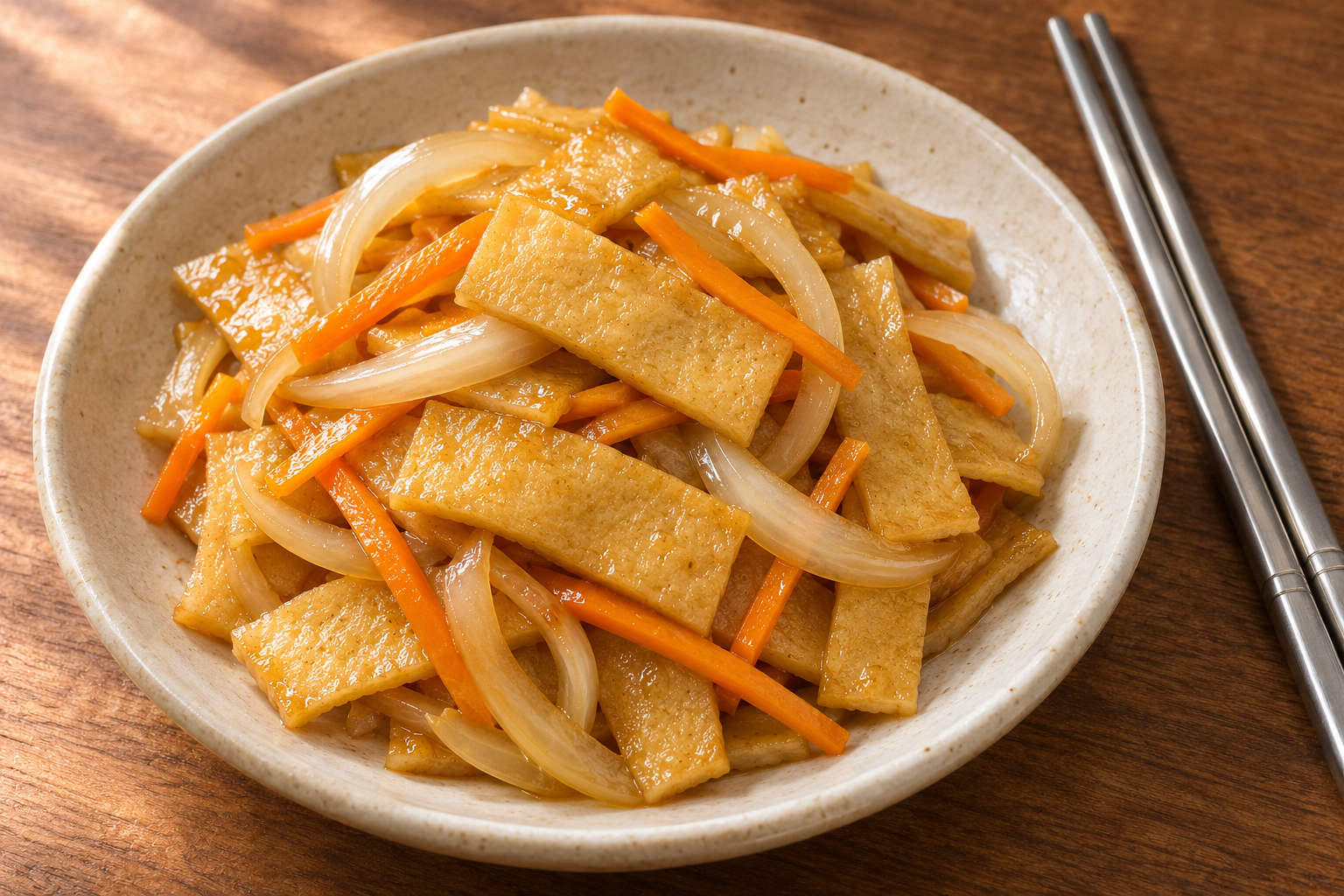
Eomuk bokkeum is a Korean banchan made with thin fish cake sheets. The sheets already have seasoning, so this recipe starts with just 1 tablespoon of soy sauce for 250 g of fish cake. A splash of water helps the sauce reach the folded pieces and keeps the edges from drying out. Keep the skillet over medium heat and stop as soon as the pieces are evenly coated.
Yield: 3–4 side-dish portions. Time: about 10 minutes to prep and 6–8 minutes to cook. The four cooking photos are AI-generated examples.
Ingredients for 3–4 side portions
- 250 g (about 9 oz) flat Korean fish cake sheets
- 80 g onion (about ½ small onion) and 40 g carrot (about ⅓ medium carrot)
- 2 teaspoons neutral cooking oil and 1 teaspoon minced garlic
- Sauce: 1 tablespoon regular soy sauce, 3 tablespoons water (45 mL) and 1 teaspoon sugar
- 1 teaspoon toasted sesame oil, optional, to finish

Which fish cakes should you buy?
Look for flat sheets labeled eomuk (어묵), especially sagak eomuk (사각어묵). A Korean or Asian grocery may stock them refrigerated or frozen near dumplings and tofu. Check the package for thawing and cooking directions. Fish cakes contain fish and may contain wheat, egg, soy or other seafood. Read the package if you’re cooking for someone with an allergy. The soy sauce and optional sesame oil add their own allergens.
1. Cut the vegetables and mix the sauce
Cut each sheet into rectangles about 4 cm by 1.5 cm. Slice the onion about 3 mm thick and cut the carrot into thin matchsticks so it cooks in the same time. Stir the soy sauce, water and sugar together in a cup. For a brand you already know is salty, start with 2 teaspoons of soy sauce and add more only after tasting the heated mixture.

2. Start with the carrots
Heat the neutral oil in a 24–26 cm (9½–10 inch) skillet over medium heat. Stir-fry the carrot for about 1 minute, then add the onion for 1–2 minutes. Look for onion edges that have just turned translucent. Stir in the garlic for 15–20 seconds, just until fragrant.
3. Coat the fish cake with sauce
Add the sliced fish cake and toss for 1 minute to loosen the pieces. Stir the sauce again, pour it into the pan and toss for 2–3 minutes at a gentle bubble. Slide the spatula across the pan. The sauce should briefly leave a trail, then flow back in a thin film. If the pan dries before the pieces are heated through, add 1 tablespoon of water. Follow any longer heating time on the fish cake package.

4. Finish off the heat
Once the pieces are heated through and evenly coated, turn off the burner. Toss with the optional sesame oil. Move the fish cake to a shallow dish so the bottom layer stays supple. Serve with rice and Korean spinach banchan, which works well alongside the soy glaze.

How to fix dry, salty or watery fish cake
- Dry edges: Lower the heat and add 1 tablespoon of water. Toss gently for 30 seconds, then take the pan off the burner.
- Too salty: Stretch with extra sliced onion and unseasoned fish cake, or serve a smaller amount with plain rice. Water alone won’t remove salt if you boil it off.
- Watery pan: Toss uncovered and check every 30 seconds. For a double batch, use a larger pan or cook in two rounds.
A small batch or a little heat
For half a batch, use 125 g of fish cake, 40 g onion and 20 g carrot. Halve the seasonings and choose a smaller skillet to slow evaporation. For a spicy batch, stir ½ teaspoon of gochugaru into the full batch of sauce. Adjust the spice after cooking.
Cool, store and reheat
Transfer leftovers to a shallow covered container and refrigerate within 2 hours of cooking, or within 1 hour above 90°F (32°C). Use refrigerated leftovers within 4 days. To reheat, add a small splash of water and heat the portion to 165°F (74°C).
Recipe and food safety references
See Korean Bapsang’s eomuk bokkeum for another way to prepare the traditional side dish. See FoodSafety.gov guidance on leftovers for storage and reheating times and temperatures.
답글 남기기