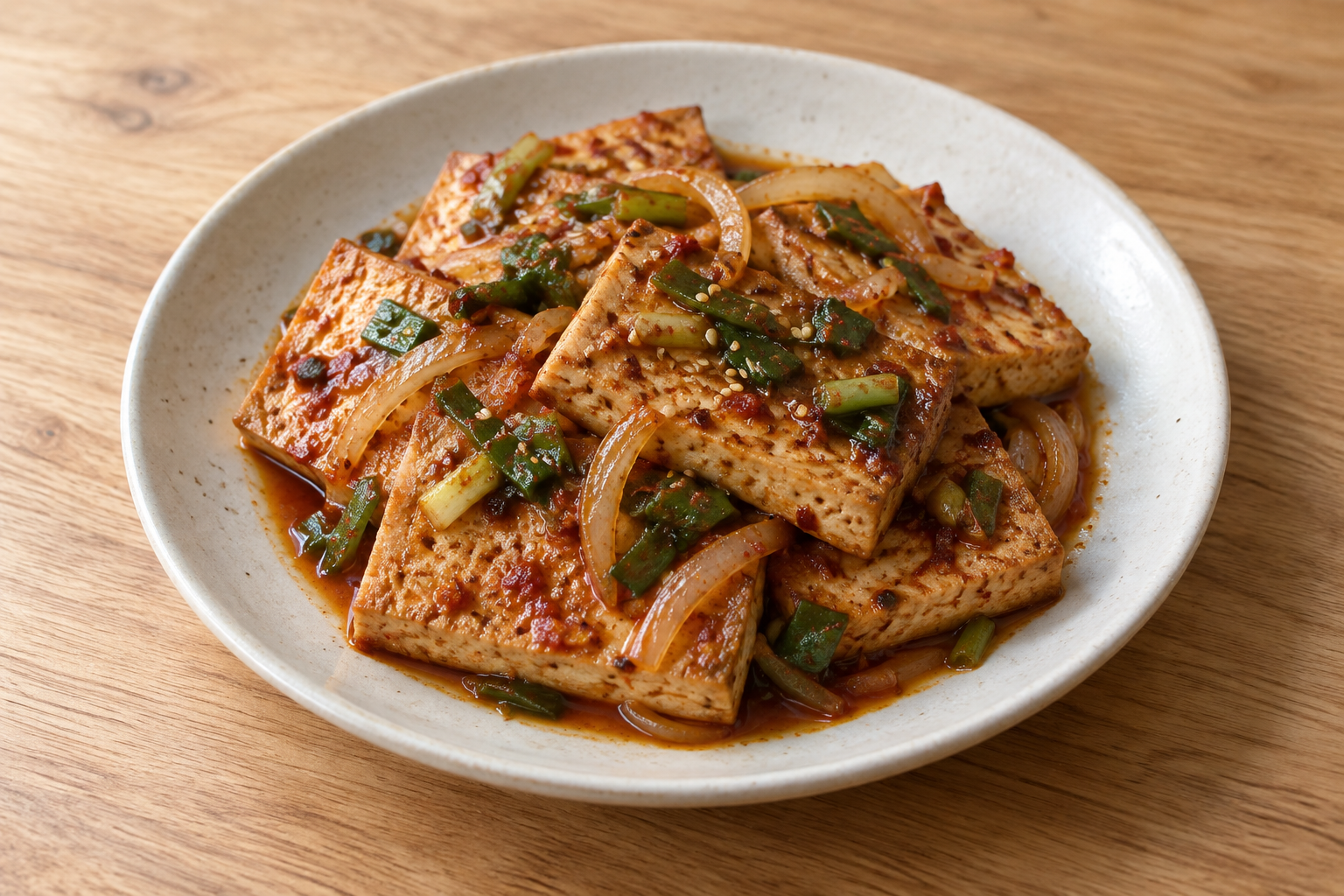
Does your tofu break apart while the sauce turns too salty? This small-pan version of dubu jorim starts with firm tofu and a modest amount of soy sauce, then lets you adjust the seasoning near the end. Dubu means tofu; jorim refers to simmering food in a seasoned liquid. Serve this Korean side dish, or banchan, alongside rice rather than treating the tofu alone as a complete meal.
Yield: 2 side-dish servings, using 300g tofu
Estimated time: 10 minutes preparation + 15–20 minutes cooking
Measurements: 1 tablespoon = 15mL; 1 teaspoon = 5mL. Use measuring spoons, not table cutlery.
The four images are AI-generated illustrations, not photos of a personally cooked or tested batch. Follow the written quantities and the actual condition of your food, rather than the amounts or colors shown in the images. Cooking times are guides, not guarantees.
Ingredients for two side-dish servings
- 300g firm tofu, about 10.6 oz by weight
- 80g onion, thinly sliced
- 20g scallions, chopped; separate white and green parts
- 1 tablespoon neutral cooking oil (15mL), for frying
- 120mL water (8 tablespoons), plus a little more if needed
- 1 tablespoon regular soy sauce to start; add up to 1 more tablespoon if needed
- 1 teaspoon gochugaru (Korean red pepper flakes), optional for a mild version
- 1 teaspoon sugar
- 1 teaspoon minced garlic
- 1 teaspoon toasted sesame oil (5mL), to finish
- 1/2 teaspoon toasted sesame seeds, optional
You will need a roughly 24cm / 9.5-inch nonstick skillet, a thin spatula, measuring utensils and clean paper towels. The tofu should fit in one layer. If your pan is smaller, sear in batches rather than stacking the slices.

Choosing tofu and Korean seasonings
Choose a block labeled firm or suitable for pan-frying; Korean packaging may say 부침용. Silken tofu is much more delicate and is not a direct swap for this sear-and-turn method. Firmness differs by brand, so handle the slices gently even when the label says firm.
Use regular soy sauce rather than automatically substituting dark soy sauce or Korean soup soy sauce, which can change the saltiness and flavor. Gochugaru is chili flakes, not gochujang paste; the paste contains other ingredients and is not an equal-volume substitute. For less heat, omit the flakes. Check every label for soy, sesame, wheat and cross-contact warnings. Tofu does not make the whole dish automatically gluten-free.
A 14oz tofu package is about 397g, leaving about 97g after you weigh out 300g. A 16oz package is about 454g, leaving about 154g. Ounces here are weight, not fluid ounces. For this recipe, 120mL water is 8 tablespoons; do not rely on an unmarked cup or assume every country’s tablespoon has the same volume.
1. Dry the tofu and mix the sauce
Drain the tofu and cut it into slices about 1cm / 3/8 inch thick. Gently blot surface moisture with clean paper towels without squeezing the block. Slice the onion and chop the scallions. In a small bowl, mix the water, 1 tablespoon soy sauce, gochugaru, sugar and garlic. Keep the sesame oil and optional sesame seeds for the finish.
2. Lightly brown both sides
Warm the skillet over medium heat and spread the neutral oil into a thin layer. Carefully lay in the dry tofu slices. Give the first side time to form a pale golden surface before turning with a spatula that supports the whole slice. Start with about 3–4 minutes per side, adjusting to your pan and stove. Reduce the heat if the edges start to blacken. Moist tofu can make hot oil splatter, so do not lean over the pan.

3. Add the onion and gently braise
Reduce to medium-low heat. Tuck the onion and scallion whites between the tofu slices, then carefully pour the mixed sauce around and over the tofu. Once it starts simmering, maintain small bubbles and cook uncovered for roughly 6–8 minutes. Spoon some liquid over the tops instead of repeatedly flipping or stirring the slices.
Look for softened onion and a little sauce still remaining on the pan bottom. If the pan starts drying before the onion softens, add 1–2 tablespoons water and lower the heat. A wider pan loses water faster, so do not cook until dry just to meet a timer. Add the scallion greens for the final 1–2 minutes.

4. Adjust the seasoning and finish
Cool a small spoonful of sauce before tasting it. If needed, add soy sauce in 1/2-teaspoon increments and simmer briefly. Starting with the full 2 tablespoons can make a heavily reduced sauce harder to adjust. Turn off the heat, drizzle over the sesame oil and add the optional sesame seeds. Support the tofu from underneath as you lift it onto a serving plate.

Common problems and useful adjustments
- The slices break apart.
- Check whether you bought very soft tofu or sliced it too thinly. Avoid moving it before the first surface firms up, and use a broad spatula rather than pinching it with tongs. Let broken pieces cook gently without further stirring.
- The sauce tastes too salty.
- Stop reducing it, lower the heat and add a tablespoon or two of water. Dilution does not remove the sodium already in the pan. Leave some sauce behind when serving and start with less soy sauce next time.
- The dish looks too watery.
- Simmer uncovered a little longer without disturbing the tofu. If the seasoning is already strong enough, serve with some liquid rather than reducing it to a salty glaze.
- Can I leave out the chili?
- Yes. Omit gochugaru for a soy-based version. Do not replace it with the same amount of chili paste or hot sauce on your first attempt.
Making a larger batch
For 600g tofu, start with 160g onion, 40g scallions, 240mL water and 2 tablespoons neutral oil in total. Start the sauce with 2 tablespoons soy sauce and adjust near the end. Use two batches if your pan is not large enough, dividing the oil and sauce between them. Doubling the ingredients does not mean doubling the time; watch the liquid level and onion tenderness.
Storing leftovers
Portion leftovers into shallow containers and refrigerate promptly at 4°C / 40°F or below. Do so within 2 hours of cooking, or within 1 hour if the surrounding temperature is above 32°C / 90°F. Smell alone cannot show that food is safe. Reheat only the portion you plan to eat; for microwave reheating, heat evenly and check that the center reaches at least 74°C / 165°F with a food thermometer. Discard food with an unknown storage history or that has not been kept properly chilled. These are general FoodSafety.gov guidelines, not a product-specific shelf-life guarantee.
More K-Food recipes in English
References and recipe notes
Korean Bapsang’s Dubu Jorim explains tofu types and the general sear-then-braise approach. Maangchi’s Dubu-jorim provides another onion-based preparation. This 300g formulation and its seasoning adjustments are separately written; those sources have not tested or endorsed this particular batch. Storage and microwave-reheating guidance comes from FoodSafety.gov: Four Steps to Food Safety. Sources checked October 7, 2026.
답글 남기기